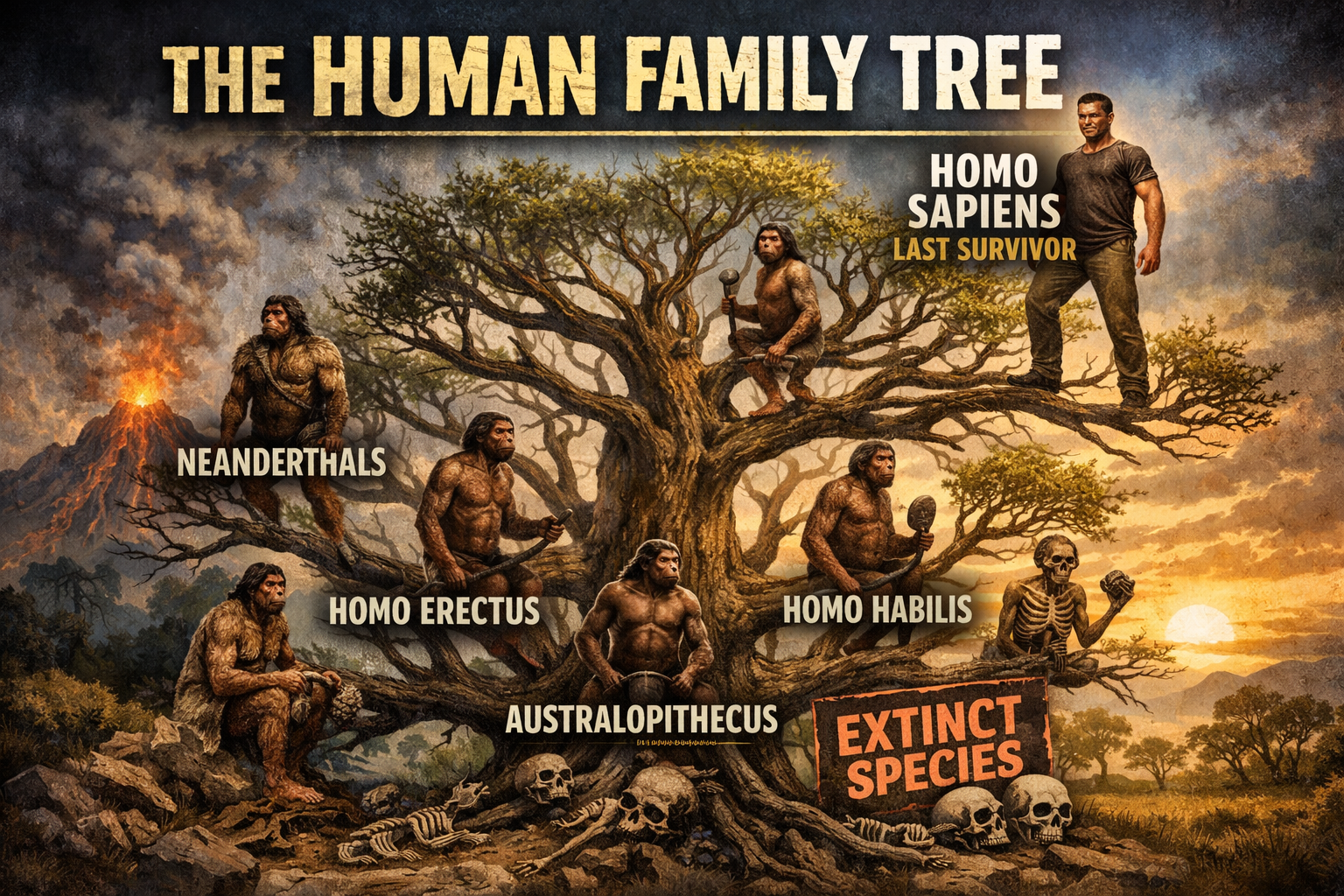
Human Evolution: The Complete Story of How We Became Human
Seven million years ago, our ancestors were tree-dwelling apes swinging through African forests. Today, we send rockets to Mars, compose symphonies, and decode our own DNA. The journey from ancient primates to modern humans is one of the most extraordinary transformations in the history of life on Earth. This is the complete story of human evolution—how we stood upright, grew bigger brains, invented language, and ultimately became the planet's dominant species.
What Is Human Evolution?
Human evolution is the lengthy process of biological and cultural change through which modern humans emerged from apelike ancestors. This transformation didn't happen overnight—it unfolded over millions of years through the mechanism of natural selection, where individuals with advantageous traits survived and passed those traits to their offspring.
Contrary to popular belief, humans did not evolve "from monkeys." Instead, humans and modern apes share a common ancestor that lived millions of years ago. We are cousins, not descendants, of today's chimpanzees and gorillas.
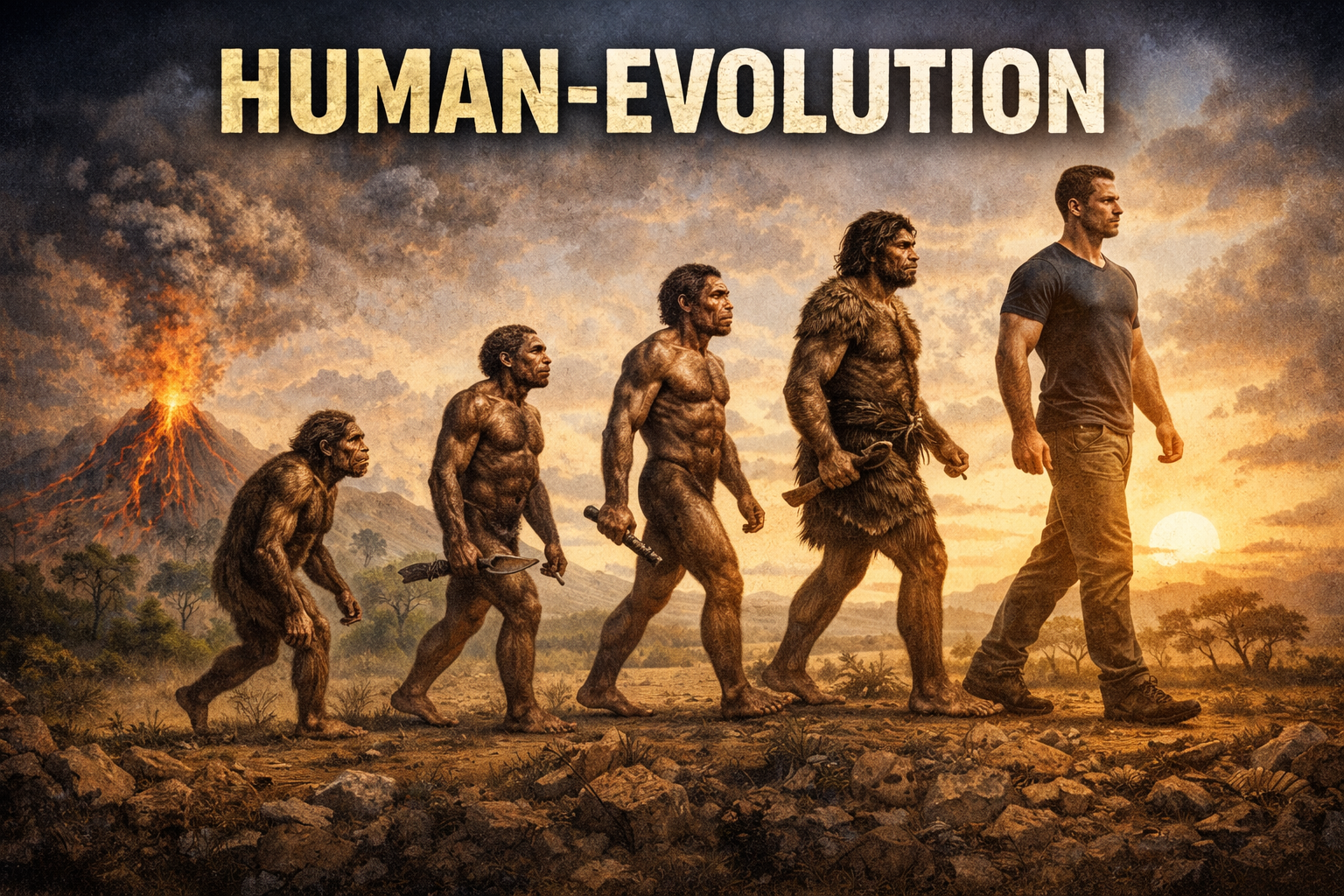
The human family tree showing the many branches of human evolution, with Homo sapiens as the sole surviving species.
The Timeline of Human Evolution 7 Million Years
Understanding when and how humans evolved requires looking at key milestones across millions of years. Here's the complete timeline:
Evolutionary Timeline: From Apes to Humans
- 7-6 MYA - Last common ancestor between humans and chimpanzees lived in Africa
- 6-4 MYA - Earliest possible bipedal ancestors (Sahelanthropus, Orrorin)
- 4-2 MYA - Australopithecus species walk upright but retain small brains
- 2.8 MYA - First stone tools appear in Africa
- 2.4-1.4 MYA - Homo habilis emerges with larger brain, nicknamed "handy man"
- 1.9 MYA - Homo erectus appears—first human to leave Africa
- 800,000 YA - Evidence of controlled fire use
- 400,000 YA - Common ancestor of modern humans and Neanderthals
- 300,000 YA - Homo sapiens emerges in Africa
- 200,000 YA - Modern human anatomy fully established
- 70,000 YA - Humans migrate out of Africa in major waves
- 40,000 YA - Cave art, complex tools, and symbolic thinking flourish
- 12,000 YA - Agricultural revolution begins
- 6,000 YA - First civilizations and written language
MYA = Million Years Ago | YA = Years Ago
The Major Stages of Human Evolution
Stage 1: The Last Common Ancestor 7-6 Million Years Ago
Around 7 to 6 million years ago, a population of apes living in Africa split into two lineages. One would eventually lead to modern chimpanzees and bonobos. The other would become the human lineage.
This common ancestor likely lived in forests, was covered in hair, walked on all fours, and had a brain roughly the size of a modern chimpanzee. What caused the split? Climate change. As Africa's climate shifted, forests fragmented into grasslands, creating new environmental pressures that favored different adaptations.
Stage 2: Walking Upright - The Australopithecines 4-2 Million Years Ago
The first major evolutionary innovation that distinguished our ancestors from other apes was bipedalism—walking upright on two legs. This revolutionary change freed our hands for carrying objects, using tools, and eventually transforming our entire body structure.
Australopithecus afarensis, perhaps the most famous early human ancestor, lived 3.9 to 2.9 million years ago. The species is best known through "Lucy," a remarkably complete skeleton discovered in Ethiopia in 1974.
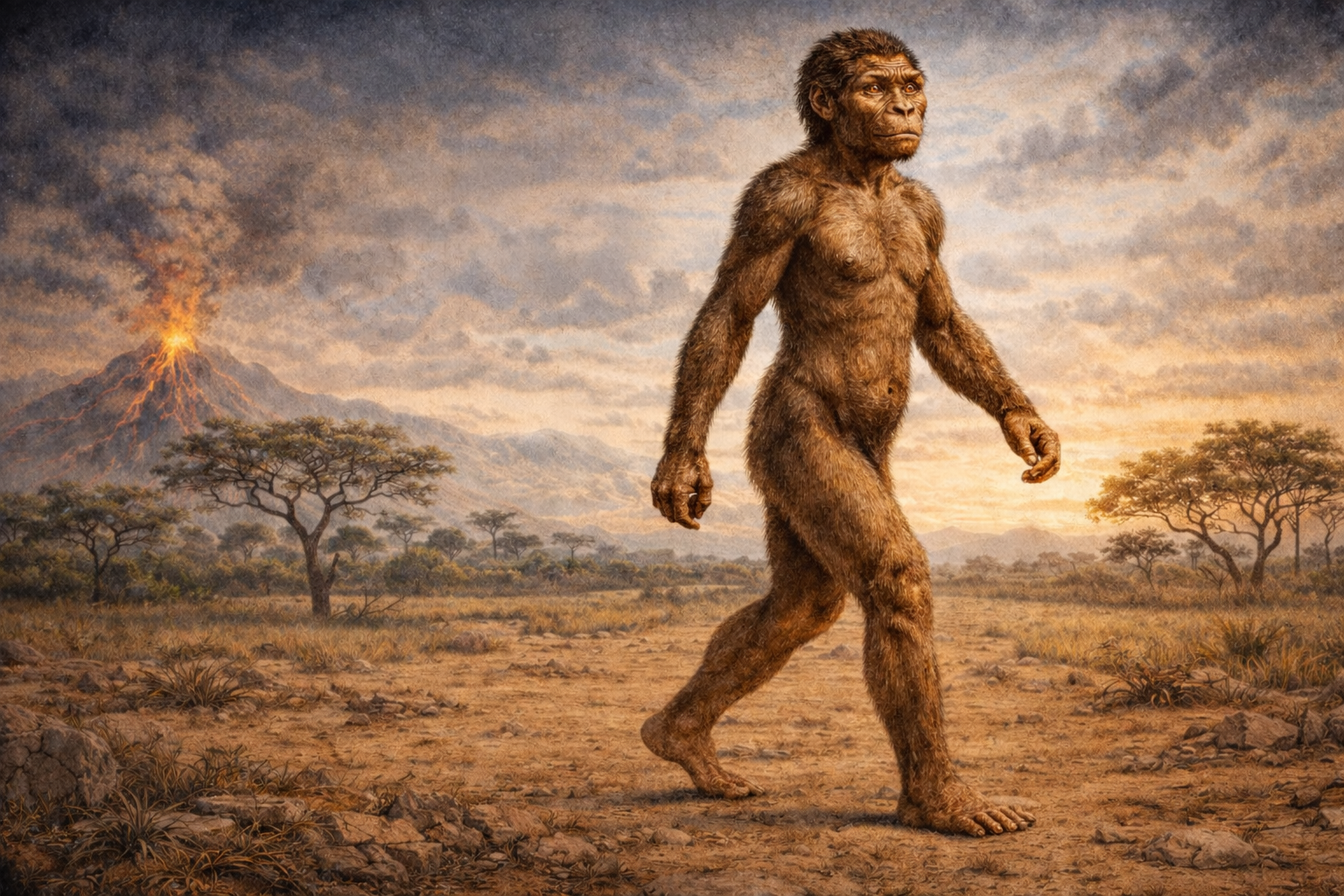
Artist's reconstruction of Australopithecus afarensis (Lucy) demonstrating upright walking while retaining some ape-like features.
Why did we start walking upright? Scientists propose several theories:
- Energy efficiency: Bipedalism uses less energy than quadrupedal knuckle-walking when covering long distances
- Heat regulation: Standing upright exposes less body surface to the intense African sun
- Seeing over tall grass: Upright posture allows better surveillance for predators and prey
- Freeing hands: Carrying food, tools, and infants becomes easier
- Wading in water: Some theorize early humans foraged in shallow water, favoring upright posture
Stage 3: The First Humans - Genus Homo 2.8-1.5 Million Years Ago
Around 2.8 million years ago, the first members of our genus, Homo, appeared in Africa. This marked the beginning of true "humans" as distinct from earlier australopithecines.
Homo habilis ("handy man") represents this transition. With brain sizes ranging from 550 to 687 cubic centimeters—larger than australopithecines but still only half the size of modern humans—H. habilis created the first stone tools, known as Oldowan tools.
These weren't sophisticated implements—just rocks deliberately flaked to create sharp edges for cutting meat and processing plants. But their creation required planning, precision, and the cognitive ability to envision a tool before making it. This cognitive leap separated humans from all other species.
Stage 4: Out of Africa - Homo erectus 1.9 Million-140,000 Years Ago
Homo erectus represents one of the most successful human species, surviving for nearly 2 million years across Africa, Asia, and Europe. This species looked remarkably human-like, with a brain size averaging 900 cubic centimeters (two-thirds of modern humans).
H. erectus was the first human species to:
- Leave Africa: Fossils found in Georgia (1.8 MYA), China, and Indonesia prove intercontinental migration
- Control fire: Evidence from 800,000 years ago shows deliberate fire use for cooking, warmth, and protection
- Create advanced tools: Acheulean hand axes required complex, multi-step manufacturing
- Hunt large game: Organized hunting of big animals required cooperation and planning
- Care for the sick: Fossils show individuals survived serious injuries, suggesting group care
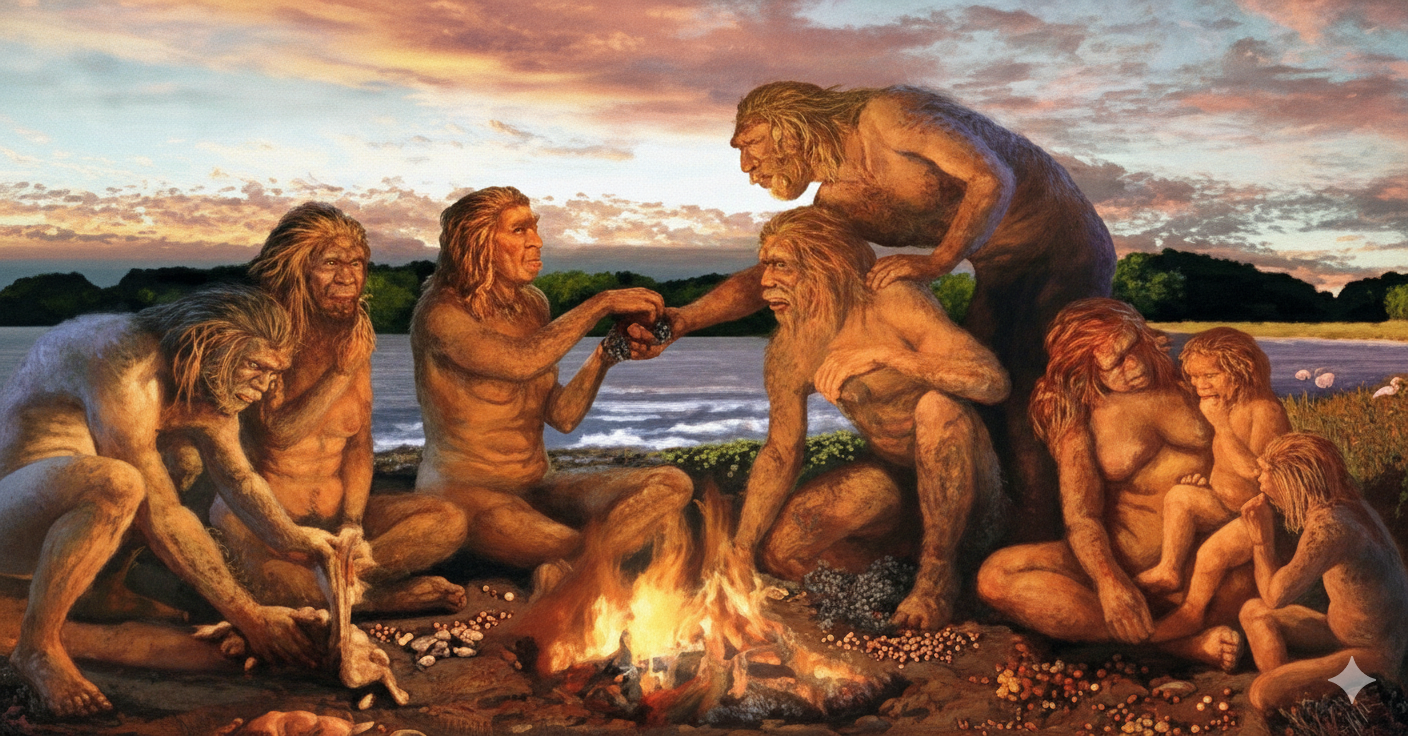
Homo erectus around a fire—the first human species to harness fire, fundamentally changing human evolution.
Stage 5: The Brain Explosion - Archaic Humans 600,000-200,000 Years Ago
Between 600,000 and 200,000 years ago, human brain size underwent rapid expansion. Species like Homo heidelbergensis possessed brains approaching modern size (1,200 cubic centimeters).
This period saw revolutionary changes:
- More sophisticated tools requiring advanced planning
- Possible early language development
- Deliberate burial of the dead (suggesting symbolic thought)
- Long-distance hunting requiring coordination
- Creation of shelters and clothing
Homo heidelbergensis is thought to be the common ancestor of three human species: modern humans (Homo sapiens), Neanderthals (Homo neanderthalensis), and Denisovans.
Stage 6: Modern Humans Emerge - Homo sapiens 300,000 Years Ago
Around 300,000 years ago in Africa, our species—Homo sapiens—emerged. The oldest known H. sapiens fossils come from Jebel Irhoud in Morocco, dating to approximately 315,000 years ago.
Early Homo sapiens had the same brain size as modern humans (approximately 1,350 cubic centimeters) but slightly different skull shapes. Over the next 100,000 years, our anatomy became fully modern.
What made Homo sapiens different from other human species?
- Higher foreheads and rounder skulls: Reflecting different brain organization
- Smaller teeth and jaws: Result of cooking and processed foods
- More gracile skeletons: Lighter bone structure than robust Neanderthals
- Prominent chins: Unique to modern humans (evolutionary purpose unknown)
- Complex symbolic behavior: Art, jewelry, ritual, and abstract thought
The Great Migration: Humans Leave Africa 70,000-60,000 Years Ago
Although anatomically modern humans evolved 300,000 years ago, they remained in Africa for over 200,000 years. Then, around 70,000 to 60,000 years ago, small groups began migrating out of Africa in waves that would eventually populate the entire planet.
This migration was driven by climate change, population pressure, and possibly the emergence of advanced cognitive abilities that allowed humans to adapt to radically different environments.
Human Migration Timeline
- 70,000 YA - Modern humans leave Africa via Middle East
- 65,000 YA - Reach Southeast Asia and Australia
- 45,000 YA - Arrive in Europe, encountering Neanderthals
- 40,000 YA - Reach Siberia and northern Asia
- 15,000 YA - Cross Bering land bridge to Americas
- 1,200 YA - Settle New Zealand (last major landmass)
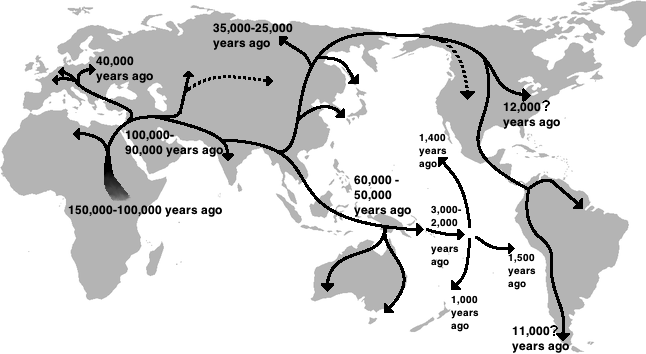
The great human migration out of Africa, showing routes and approximate dates of human arrival across continents.
Our Evolutionary Cousins: Other Human Species
For most of human evolutionary history, multiple human species coexisted on Earth. Modern humans are unique in being the only surviving human species, but we once shared the planet with close relatives.
Neanderthals: Our Closest Relatives
Homo neanderthalensis lived in Europe and western Asia from about 400,000 to 40,000 years ago. Far from the brutish cave-dwellers of popular imagination, Neanderthals were sophisticated humans who:
- Had larger brains than modern humans (1,500 cubic centimeters)
- Created complex tools and weapons
- Controlled fire and built shelters
- Cared for injured and elderly individuals
- Buried their dead with apparent ritual
- Created cave art and symbolic objects
- Possibly had language (anatomical evidence suggests speech capability)
Denisovans: The Mystery Cousins
Discovered only in 2010 through DNA analysis of a finger bone from Siberia, Denisovans are our most recently identified human relatives. We know little about their appearance, but their DNA tells an extraordinary story.
Denisovans interbred with modern humans in Asia, and their genes helped populations adapt to high altitudes. Tibetans, for instance, carry a Denisovan gene variant that aids oxygen absorption at extreme elevations—a genetic gift from our extinct cousins.
Homo floresiensis: The "Hobbits"
Discovered in Indonesia in 2003, Homo floresiensis stood just 3.5 feet tall with a brain one-third the size of modern humans. Yet these "hobbits" used sophisticated tools, hunted, and controlled fire.
Living as recently as 50,000 years ago, they demonstrate that human evolution was far more diverse and complex than once believed. Their small size likely resulted from island dwarfism—an evolutionary response to limited resources on islands.
What Makes Humans Unique?
While we share 98.8% of our DNA with chimpanzees, that small genetic difference translates into profound behavioral and cognitive distinctions. What evolutionary changes made us uniquely human?
| Trait | Evolutionary Advantage | When It Evolved |
|---|---|---|
| Bipedalism | Freed hands, energy efficiency, better vision over grasslands | 6-4 million years ago |
| Large brains | Enhanced problem-solving, planning, social cognition, language | 2 million - 200,000 years ago |
| Complex language | Precise communication, cultural transmission, abstract thought | 200,000 - 50,000 years ago |
| Opposable thumbs | Precision grip for tool-making and manipulation | Inherited from primate ancestors |
| Reduced body hair | Improved cooling during persistence hunting in hot climates | 2-1 million years ago |
| Extended childhood | Longer learning period, complex skill development | 1 million - 300,000 years ago |
| Cooperative breeding | Shared childcare, larger social groups, knowledge transmission | 1 million+ years ago |
| Advanced tool use | Access to new food sources, shelter construction, hunting | 2.8 million years ago onwards |
The Human Brain: Our Evolutionary Masterpiece
The human brain tripled in size over the past 2 million years—the fastest brain expansion of any mammal. But size alone doesn't explain our intelligence. What matters is brain organization and efficiency.
The human brain consumes 20% of our body's energy despite being only 2% of body weight. This enormous energy investment required:
- High-quality diet: Cooking and meat-eating provided energy-dense nutrition
- Smaller gut: Less energy devoted to digestion meant more for the brain
- Extended childhood: More time for brain development and learning
- Social cooperation: Sharing food and childcare supported larger brains
Language: The Communication Revolution
Human language is unparalleled in the animal kingdom. While many animals communicate, only humans possess true language with:
- Infinite generativity: We can create unlimited new sentences from finite words
- Abstract concepts: We discuss ideas, past events, and hypothetical futures
- Complex grammar: Sophisticated rules govern word arrangement and meaning
- Cultural transmission: Language carries accumulated knowledge across generations
When did language evolve? Anatomical evidence suggests that by 200,000 years ago, humans had the vocal anatomy necessary for complex speech. The FOXP2 gene, crucial for speech and language, underwent significant changes in humans around this time.
However, full modern language with complex grammar likely emerged more recently—perhaps 100,000 to 50,000 years ago, coinciding with the explosion of symbolic artifacts, art, and complex tools.
The Cultural Revolution: When Humans Became Modern 50,000-40,000 Years Ago
Around 50,000 to 40,000 years ago, something remarkable happened. Archaeological sites suddenly contain:
- Cave paintings: Sophisticated art depicting animals, humans, and abstract symbols
- Jewelry and adornment: Beads, pendants, and decorative objects with no practical function
- Musical instruments: Bone flutes capable of producing musical scales
- Elaborate burials: Bodies buried with tools, food, and ornaments suggesting belief in afterlife
- Long-distance trade: Materials transported hundreds of miles from their sources
- Advanced weapons: Throwing spears, bows and arrows, and specialized hunting tools
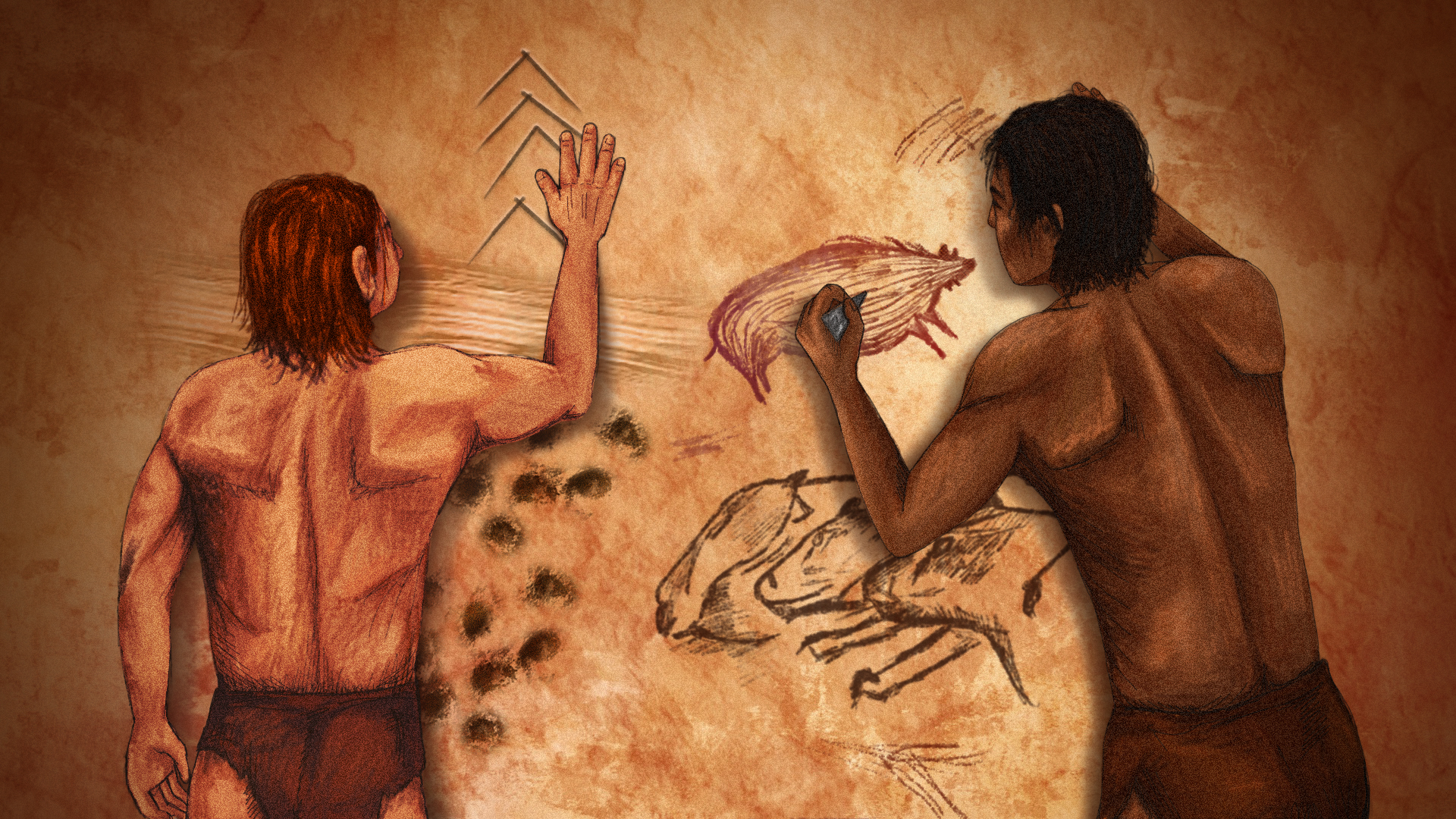
Cave art from Lascaux, France (17,000 years ago) demonstrates sophisticated artistic ability and symbolic thinking.
This "Upper Paleolithic Revolution" or "Great Leap Forward" marked the emergence of fully modern human cognition. What caused this transformation remains debated:
- Genetic mutation: A neural reorganization that enabled complex symbolic thought
- Language development: Full grammatical language unlocking new cognitive capabilities
- Population density: More people meant more innovation and cultural exchange
- Gradual accumulation: Cultural knowledge slowly building to a tipping point
Recent Human Evolution: We're Still Evolving
Many people believe human evolution stopped once modern humans emerged, but nothing could be further from the truth. Humans continue evolving, with some changes occurring within the last 10,000 years:
- Lactose tolerance: The ability to digest milk as adults evolved independently in multiple populations within the last 10,000 years, after dairy farming began
- Blue eyes: A genetic mutation that appeared 6,000-10,000 years ago near the Black Sea
- High-altitude adaptation: Tibetans evolved genetic changes allowing efficient oxygen use at extreme elevations
- Malaria resistance: Sickle cell trait evolved in Africa as protection against malaria
- Smaller teeth and jaws: Ongoing reduction as cooked food requires less chewing
Modern medicine, technology, and global interconnection have altered evolutionary pressures, but evolution hasn't stopped—it's just changed direction. Selection now favors different traits than in our prehistoric past.
Why Understanding Human Evolution Matters
Studying human evolution isn't just academic curiosity—it has profound implications for understanding ourselves:
1. Health and Medicine
Many modern health problems stem from our evolutionary past. Our bodies evolved for hunter-gatherer lifestyles, not sedentary modern life. Understanding this "evolutionary mismatch" explains:
- Why we crave sugar and fat (scarce in ancestral environments, now abundant)
- Why back pain is common (recent bipedalism caused spinal vulnerabilities)
- Why we suffer from "diseases of civilization" like diabetes and heart disease
- How our immune systems evolved and sometimes overreact (allergies, autoimmune diseases)
2. Human Behavior and Psychology
Evolutionary psychology reveals why we think and behave as we do:
- Our social nature evolved for small, cooperative groups
- Fear of snakes and heights reflects ancient survival pressures
- Preference for savanna-like landscapes may echo our African origins
- Parental love and childhood attachment served evolutionary functions
3. Human Unity and Diversity
Evolution proves all humans are one species with a recent common origin in Africa. Racial categories have no biological basis—genetic diversity within populations exceeds diversity between them. We are all Africans, separated by mere tens of thousands of years.
Common Misconceptions About Human Evolution
Myth 1: "Humans evolved from monkeys"
Reality: Humans and monkeys share a common ancestor that lived millions of years ago. We're cousins, not descendants.
Myth 2: "Evolution is just a theory"
Reality: In science, "theory" means a well-substantiated explanation supported by massive evidence. Evolution is both a fact (species change over time) and a theory (the explanation for how it happens).
Myth 3: "Evolution has a goal or direction"
Reality: Evolution has no purpose or endpoint. It's simply adaptation to changing environments through natural selection.
Myth 4: "Humans are the pinnacle of evolution"
Reality: Every living species is equally "evolved" and well-adapted to its environment. Humans aren't "better" than other species—just different.
Myth 5: "Evolution means survival of the strongest"
Reality: Evolution favors the "fittest"—those best adapted to their environment. This often means cooperation, intelligence, and social skills rather than physical strength.
The Future of Human Evolution
Where is human evolution headed? While predicting the future is speculative, several factors will shape our evolutionary trajectory:
- Technology: Medicine and technology reduce traditional selective pressures but create new ones
- Global migration: Increased genetic mixing between populations
- Environmental change: Climate change and urbanization create new selective pressures
- Genetic engineering: CRISPR and gene therapy may allow directed evolution
- Space colonization: Living off Earth could drive rapid evolutionary changes
Some scientists suggest that cultural evolution—changes in knowledge, technology, and society—has largely replaced biological evolution as the primary driver of human change. We adapt through learning and innovation rather than genetic mutation.
Conclusion: The Remarkable Journey
Human evolution is one of the most extraordinary stories in natural history. From tree-dwelling apes to beings capable of understanding our own origins, we've undergone a transformation that seems almost miraculous.
Yet this journey wasn't guided by purpose or destiny. It was shaped by random mutations, environmental pressures, and the simple logic of natural selection: those who survived passed on their traits. Over millions of years, these small changes accumulated into the profound differences that make us human.
We are the only surviving branch of a once-diverse human family tree. Neanderthals, Denisovans, Homo erectus, and countless others are gone, leaving us alone. But their legacy lives on—in our DNA, in the tools they left behind, and in the evolutionary innovations that made modern humans possible.
From the African savanna to the moon, from stone tools to smartphones, from cave art to the internet—the human journey continues. We are evolution in action, still changing, still adapting, still becoming. The story of human evolution is not finished. It's still being written, one generation at a time.